


Back to Top
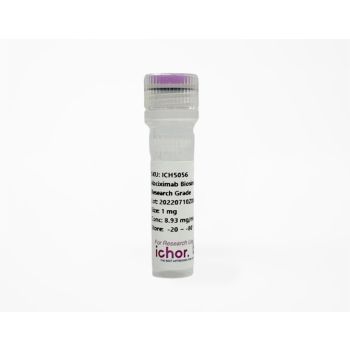
Secukinumab Biosimilar - Research Grade
$315.00 - $19,890.00
Frequently Bought Together


Loading...
Secukinumab Biosimilar - Research Grade
Endotoxin
≤ 1.0 EU/mg as determined by the LAL method
Purity
>95% by SDS-PAGE and HPLC
Species Reactivity
Human
Target
IL17A
Concentration
>1mg/ml
Isotype
Human IgG1 Kappa
Host
Humanized
Antibodies Against The Same Target
Ixekizumab Biosimilar - Research Grade (ICH5165), Xeligekimab Biosimilar - Research Grade (ICH5289), Afasevikumab Biosimilar - Research Grade (ICH5330), Bimekizumab Biosimilar - Research Grade (ICH5403), Gumokimab Biosimilar - Research Grade (ICH5586), Netakimab Biosimilar - Research Grade (ICH5709), Perakizumab Biosimilar - Research Grade (ICH5769), Roconkibart Biosimilar - Research Grade (ICH5829), Vunakizumab Biosimilar - Research Grade (ICH5995)
Sequence
https://www.imgt.org/mAb-DB/
Buffer
ICH3001-100ml
ICH3002-100ml
ICH3003-100ml
Uniprot
Q16552
Gene Id
3605
Rrid
RRID:AB_2921548
Shipping Conditions
Blue ice
Background
This product is a research-grade, unconjugated recombinant analog of secukinumab, a fully human IgG1-kappa monoclonal antibody directed against human interleukin-17A (IL-17A, UniProt Q16552). It is a non-therapeutic biosimilar intended strictly for research use only; it is not the clinical drug and is not for human or veterinary use. Reproducing the published antigen specificity and human IgG1-kappa framework of the originator, it is a useful reference reagent for studying IL-17A biology, benchmarking IL-17A-targeting molecules, and serving as an isotype-matched, well-defined positive control in binding and neutralization assays. Because it is offered at research scale, it supports method development, assay standardization, and in-vitro and preclinical workflows where a consistent, well-characterized anti-IL-17A antibody is needed. It is available in bulk quantities (milligram to gram) and in low-endotoxin grades (research grade less than 1 EU/mg; ultra-low less than 0.5 EU/mg) suitable for cell-based and sensitive functional experiments. Format is unconjugated, leaving it open for downstream labeling, immobilization, or engineering.
Interleukin-17A (IL-17A) is a pro-inflammatory cytokine and the founding member of the IL-17 family. It is produced chiefly by Th17 CD4+ T cells, but also by CD8+ T cells, gamma-delta T cells, innate lymphoid cells, natural killer cells, and neutrophils. IL-17A is secreted as a disulfide-linked homodimer and can also form heterodimers with IL-17F. It signals through a receptor complex of IL-17RA and IL-17RC, recruiting the adaptor ACT1 to drive NF-kB, MAPK, and C/EBP signaling. This induces expression of pro-inflammatory cytokines, chemokines (including CXCL1, CXCL8/IL-8), antimicrobial peptides, and matrix metalloproteinases from epithelial cells, fibroblasts, and keratinocytes. IL-17A supports host defense against extracellular bacteria and fungi, but its dysregulation is central to autoimmune and inflammatory diseases such as psoriasis, psoriatic arthritis, and ankylosing spondylitis, making it a validated therapeutic and research target.
Other Names
Interleukin-17A, IL17A, CTLA-8, CTLA8
Specificity
Detects human IL17A. This non-therapeutic antibody uses the same sequence as the therapeutic antibody Secukinumab.
Purification Method
This monoclonal antibody was purified using multi-step affinity chromatography methods such as Protein A or G depending on the species and isotype.
Formulation
Phosphate buffered saline (PBS) pH 7.2,with no carrier protein, potassium or preservatives added. BSA and Azide free.
Storage
Stable for at least one week when stored sterile at 2-8°C. For long term storage aseptically aliquot in working volumes without diluting and store at –80°C. Avoid Repeated Freeze Thaw Cycles.
Use
Products are for research use only. Not for use in diagnostic or therapeutic procedures.
Bio X Cell Code
SIM0013
Suggested H1
Secukinumab (anti-IL17A) Biosimilar
Faq (q&a)
Q: Is the Secukinumab biosimilar available in gram quantities?
A: Yes — it is supplied in scalable milligram to gram quantities for heavy-usage and high-throughput laboratories.
Q: Is this research-grade Secukinumab suitable for in vivo studies?
A: Yes, it is a low-endotoxin, in vivo-ready formulation intended for preclinical and in vivo research use only (RUO).
Q: What does the Secukinumab biosimilar target?
A: It is an unconjugated, non-therapeutic analog of Secukinumab that binds human IL17A.
Write Your Own Review
Is the Secukinumab biosimilar available in gram quantities?
Yes — it is supplied in scalable milligram to gram quantities for heavy-usage and high-throughput laboratories.
Is this research-grade Secukinumab suitable for in vivo studies?
Yes, it is a low-endotoxin, in vivo-ready formulation intended for preclinical and in vivo research use only (RUO).
What does the Secukinumab biosimilar target?
It is an unconjugated, non-therapeutic analog of Secukinumab that binds human IL17A.
Who Viewed This Also Viewed

Anti-Mouse LAG-3 (C9B7W) In Vivo Antibody - Low Endotoxin
$400.00 - $3,780.00

Anti-CD80 (16-10A1) In Vivo Antibody - Low Endotoxin
$400.00 - $3,780.00


Anti-Mouse RANKL (IK22/5) In Vivo Antibody - Low Endotoxin
$400.00 - $3,780.00


Add recommended extras
-
 In Vivo Buffer pH7.2$112.50
 -
 Bulk Human IgG1 (IB1) Isotype Control$510.00 - $3,930.00
